Don't Buy the Bins Yet
I reorganized two cabinets recently. Neither one was a crisis — but both had gotten to the point where finding anything required moving everything else first. Items stacked on top of each other, categories mixed together, decorative figurines sharing space with baking supplies, gardening tools, lunch boxes and specialty ice trays. It looked like too much stuff for too little space.
It wasn't.
Before touching anything, I had a conversation with my wife about what actually lived in those cabinets and what she needed to be able to access easily. That conversation changed the entire approach before I'd moved a single thing. One cabinet would be entirely for her baking items and cookbooks. The other would get the gardening supplies, the lunch boxes, and the ice trays. Everything else would need to find a home somewhere else.
Then I started sorting.
---
What the sort revealed
As I pulled everything out and grouped like items together, something became clear that wasn't visible before. I wasn't combining things into existing containers — I was consolidating them. Items that had been spread across four partially-filled bins turned out to belong in one. Categories that looked separate were actually the same thing stored inconsistently.
By the time the sort was done, I had empty containers left over.
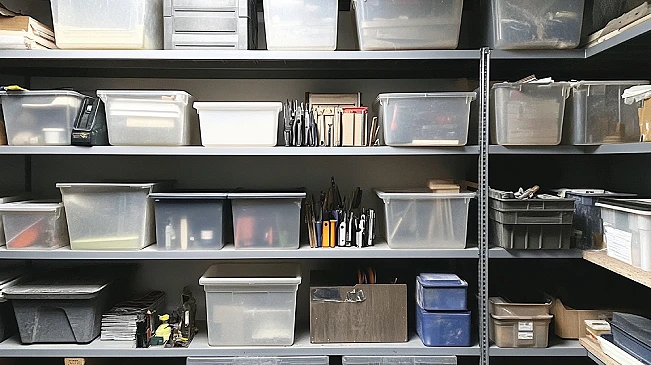
Not a shortage of containers. A surplus. Bins that had been filled with mixed or unnecessary items turned out to be exactly the right size once they were cleared and sorted. The containers were already there. They just had the wrong things in them.
The figurines were the one remaining issue — those still need to go through my wife before any decisions get made. A small pile of items needed new homes elsewhere in the house. But the cabinets themselves? Two categories, two clean spaces, everything accessible without moving anything else first. The problem that looked like too much stuff was actually a sorting problem wearing a volume problem's clothes.
---
The wrong starting point
When most people decide they need to get organized, the first move is to go shopping. Bins. Baskets. Drawer dividers. Label makers. The Container Store. Amazon. The organizing content that inspired the decision in the first place almost always ends with a product recommendation — here's what you need to make this work.
The problem is that you don't know what you need until after you sort. Buying containers first is the wrong sequence. It's a solution applied before the diagnosis.
Think about what buying first actually produces. You come home with bins in sizes that felt right at the store. You start filling them. Some things fit. Some don't. You make compromises — this goes here because it fits, not because it belongs here. The category structure gets determined by the containers you bought rather than by what actually makes sense for how you use the space. The system is built around the wrong thing.
Then six months later the space is cluttered again and you can't figure out why the system didn't hold. The system didn't hold because it was never really a system. It was stuff in bins.
---
Sort first. Shop if you have to.
The sort is the diagnosis. It tells you what categories actually exist in a space, how much of each category you have, and what kind of storage would actually serve how you use things. None of that information is available before the sort. All of it is available after.
Once you can see the categories clearly, the container question answers itself. Sometimes you need nothing — the containers you already have, once emptied of the wrong things, are exactly right for the correct categories. That's what happened in the cabinets. A surplus of partially-filled bins became the right number of properly-filled ones once the sorting was done.
Sometimes you need one specific thing — a container of a particular size for a category that doesn't have a home yet. That's a targeted purchase based on actual information. It's very different from buying an assortment and hoping something fits.
And sometimes, rarely, you genuinely need more storage. But you won't know that until after the sort. And you'll know exactly what you need because the sort showed you.
---
The industry gets this backwards on purpose
The organizing content ecosystem has a structural incentive to put shopping before sorting. Content that ends with "here's what to buy" generates affiliate revenue. Content that ends with "here's how to think about what you already have" doesn't. The before-and-after photo is more satisfying when it includes new matching bins. A reorganized space using existing containers doesn't photograph as well as one with a full set of labeled baskets from the same collection.
None of that serves you. It serves the content.
The actual sequence is simple and it doesn't require a trip to the store to start. Pull everything out. Sort by category. See what you have and how much of it. Evaluate the containers you already own against the categories you just discovered. Fill the gaps — and only the gaps — with targeted purchases if needed.
Most of the time, the containers are already there. You just couldn't see them until you sorted.
Don't Buy the Bins Yet
I reorganized two cabinets recently. Neither one was a crisis — but both had gotten to the point where finding anything required moving everything…
Share this post
Keep Reading
If you enjoyed the article above, here are more you might find interesting.

Why Organized People Close Loops
One of the things I’ve struggled with as a parent is teaching my kids the idea that mess is everyone’s problem. When they’re young, just getting them to…
Read more →
What Are You Really Keeping It For?
The books came from a specific period in my life — the years between businesses, when I was in transition and accumulating things that felt like preparation…
Read more →
Where Do You Start? Anywhere That's Calling You.
It's one of the most common questions in organizing. Where do I start? The honest answer is that it depends — and not in the way that feels like a…
Read more →