You Can't Declutter Your Way Out of This
Most organizing advice is solving the wrong problem.
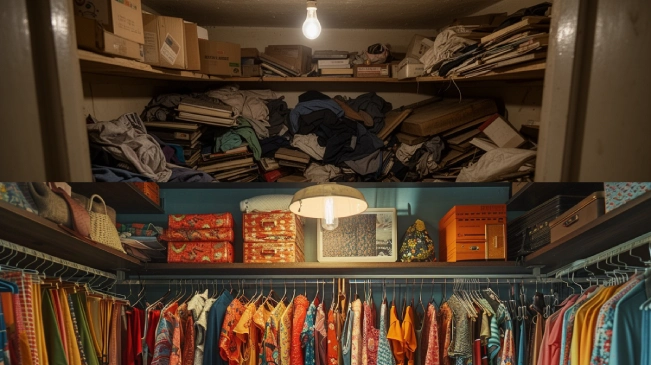
It treats the accumulation. It sorts, stores, and manages what's already there. It helps you clear the closet, organize the drawer, reclaim the shelf. And it works — right up until the point where it doesn't, which is usually a few months later when the same spaces need attention again.
The problem isn't the system. The problem is what keeps arriving.
---
I rewatched a documentary recently called Buy Now! The Shopping Conspiracy on Netflix. The examples are hard to forget — mountains of discarded clothing shipped to countries that didn't ask for them, electronics stripped of value before most people are done with them, microplastics now embedded in places they can never fully be removed from. Behind it is the machinery: pricing that makes disposal cheaper than repair, marketing that manufactures urgency around things that didn't exist as needs an hour earlier, algorithms that learn what you paused on and use that hesitation to close the gap between browsing and buying. A system built not to satisfy demand but to create it, continuously, without ceiling.
It connected something I already knew about staying organized.
Every organizing problem has a procurement history. The full bin, the overflowing drawer, the closet that won't close — none of it appeared. It was bought, ordered, accepted, accumulated over time. Each piece entered through a decision, most of them small, fast, and long forgotten by the time the pile becomes a problem.
There's a line that circulates on Pinterest: "Look around. All that clutter used to be money." It's blunt, but accurate. The clutter isn't just stuff taking up space. It's a record of decisions — mostly made quickly, often under pressure from a system designed to make slowness feel like loss.
---
The organizing industry and the consumption industry live in the same ecosystem. They feed each other. A recent article from a major home publication rounded up ten "professional organizer-approved decluttering hacks." Every single one was a product you could buy on Amazon. The professionals weren't teaching you to think differently about your stuff. They were recommending purchases — and the publication was earning a commission on every click. The hack for managing too many water bottles wasn't "stop accumulating water bottles." It was a $20 rack so you could keep all of them more efficiently. Declutter your space by buying more things to contain the things you already have.
That's the loop. You accumulate. The accumulation becomes unmanageable. You watch a satisfying decluttering video, buy some storage bins, clear out the excess, feel relief. Then it starts again — because the intake never stopped. Decluttering content and shopping content exist in the same feeds, served by the same algorithm. Clear out your closet. Here are ten things to replace what you just got rid of. The system is not designed to resolve the problem. It's designed to keep you engaged with it.
And once you see it, the pattern is easy to understand.
What makes this hard to see, though, is that the organizing failure feels personal. You cleared this space six months ago. You had a system. You were doing well. And now it's back. The natural conclusion is that something is wrong with you — your habits, your discipline, your follow-through. But that's the wrong diagnosis. If you find yourself organizing the same categories repeatedly, the intake is overwhelming the system. That's not a character flaw. That's math.
And sometimes the intake accelerates precisely because the system has broken down. When I cleaned out my father's garage after he passed, I found duplicates and triplicates of several items he owned — not because he was careless, but because he couldn't find or remember what he had, so he bought another. A system overwhelmed by intake eventually stops working. A system that stops working generates more intake because you can no longer see what you already own. The loop tightens.
No framework closes that gap on its own. The closet isn't the problem. The closet is where the problem becomes visible.
---
This is where most organizing content stops short. It hands you a method — container rules, time-based rules, one-in-one-out — and sends you back into an environment that is actively working against it. Some of those methods are genuinely useful. But a method applied to unchanged intake is a bucket under a leak. It manages the symptom without touching the source.
Most people who feel disorganized aren't. They're overwhelmed by intake they haven't named as the problem yet. They keep reaching for better systems, better methods, better storage solutions — and finding that none of them hold. Not because organizing doesn't work, but because they're applying an organizing solution to a consumption problem.
---
This isn't a minimalism argument. The goal isn't to own less for its own sake. The issue isn't volume. It's the gap between what comes in and what your system can handle. When that gap stays wide enough, long enough, no amount of organizing closes it permanently — it just resets the clock.
Organizing works. SADP works. Any thoughtful system applied consistently works. But a system is only as sustainable as the environment it operates in. Build the best organizing framework you want — if intake keeps outpacing it, you'll spend your time maintaining a cycle instead of living inside a system that holds.
The cycle of accumulate, organize, accumulate, organize doesn't end with a better method.
It ends when the intake changes. Until then, you're just resetting the system.
You Can't Declutter Your Way Out of This
I rewatched a documentary recently called Buy Now! The Shopping Conspiracy on Netflix. The examples are hard to forget — mountains of discarded…
Share this post
Keep Reading
If you enjoyed the article above, here are more you might find interesting.

Sometimes the Best Thing You Can Do Is Ask a Question
She slid into the room and started handing things out to me — bins, boxes, white garbage bags full of flowers, whatever she could reach as she dug…
Read more →
The System Does the Thinking. You Just Have to Build It.
Nobody builds a system and immediately feels at home in it. The first month I was seriously tracking finances, it was slow. I made decisions about…
Read more →
The Great Cord Purge
Yesterday, the SADP method came knocking in the form of a wall-mounted power strip crisis. My father-in-law's model airplane collection has apparently…
Read more →